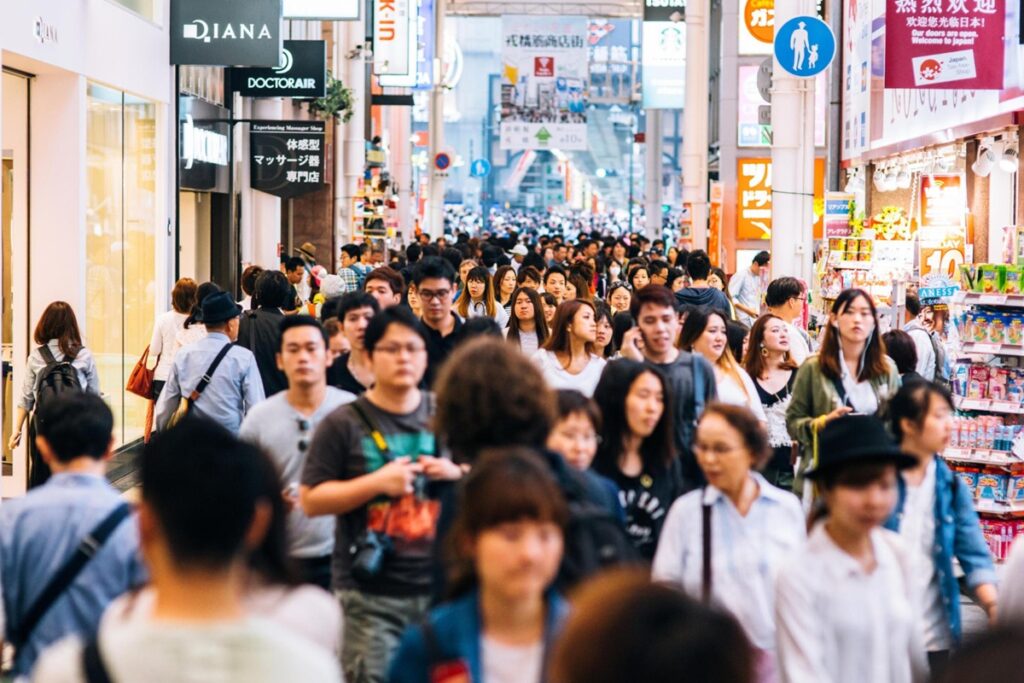
Japan’s entire landmass is slightly smaller than California, yet it holds more than three times as many people as the country’s most populous state.
A country built on a fifth of its own land
Mountains cover 71% of Japan, leaving only about a fifth of the country flat enough to live on, roughly 80,500 square kilometers for 124 million people.
That squeeze shows up on the coast: parts of eastern Honshu pack in more than 800 people per square kilometer, among the densest stretches of inhabited land anywhere on Earth.
More people than California, in less space
Japan’s four main islands, Hokkaido, Honshu, Shikoku and Kyushu, hold 95% of the country’s land area, and together they’re smaller than California.
The Greater Tokyo Area alone is home to more than 35 million people, the most populous urban area on the planet, and on its own it comes close to matching California’s entire population in a single metro region.
One archipelago, two climates
Japan stretches more than 3,000 kilometers from north to south, roughly the distance from Quebec to Cuba, and the weather at each end barely resembles the other.
Hokkaido, in the north, gets the kind of heavy snow and continental winters familiar to anyone in the upper Midwest. The Ryukyu Islands, far to the south, sit at the latitude of Taiwan and stay nearly tropical year round, with no frost and no snow.
Built to survive what shaped it
Japan counted 111 active volcanoes as of 2018, and roughly a fifth of the world’s magnitude 6+ earthquakes happen within its borders.
The 2011 Tohoku earthquake measured magnitude 9.0, yet strict building codes meant the shaking itself killed relatively few people. It was the tsunami that followed, not the quake, that caused most of the roughly 20,000 deaths and the Fukushima nuclear accident.
Typhoons add another layer of risk most years between June and October. The 1934 Muroto typhoon killed about 3,000 people, and the 1959 Ise Bay typhoon killed roughly 5,000, among the deadliest storms in the country’s modern history.
More industrial robots than anywhere else
Squeezed for labor and land alike, Japan has leaned hard into automation. The country runs about 410,000 of the world’s 720,000 industrial robots, or 57% of the global total.
No other country comes close to that share, a side effect of trying to keep an aging, dense economy running on a shrinking workforce.
A population already shrinking
That workforce problem traces back to a demographic shift that started in 2009, when Japan’s population began to decline. Current projections put the population at 124 million today, falling to around 90 million by 2050 and below 60 million by 2100.
In other words, the country squeezing more than three times California’s population onto a smaller landmass today could end up with less than half its current headcount within a lifetime.
Still pulling in record crowds
None of that kept tourists away. Japan welcomed a record 36.9 million foreign visitors in 2024, making it Asia’s most visited country that year.
Many of them soak in onsen, natural hot spring baths that run between 104 and 149 degrees Fahrenheit, or climb toward Mount Fuji, an active volcano standing 12,388 feet tall that last erupted in 1707 and is still watched closely today. A country this short on flat ground somehow keeps finding room for both 124 million residents and millions more visitors every year.